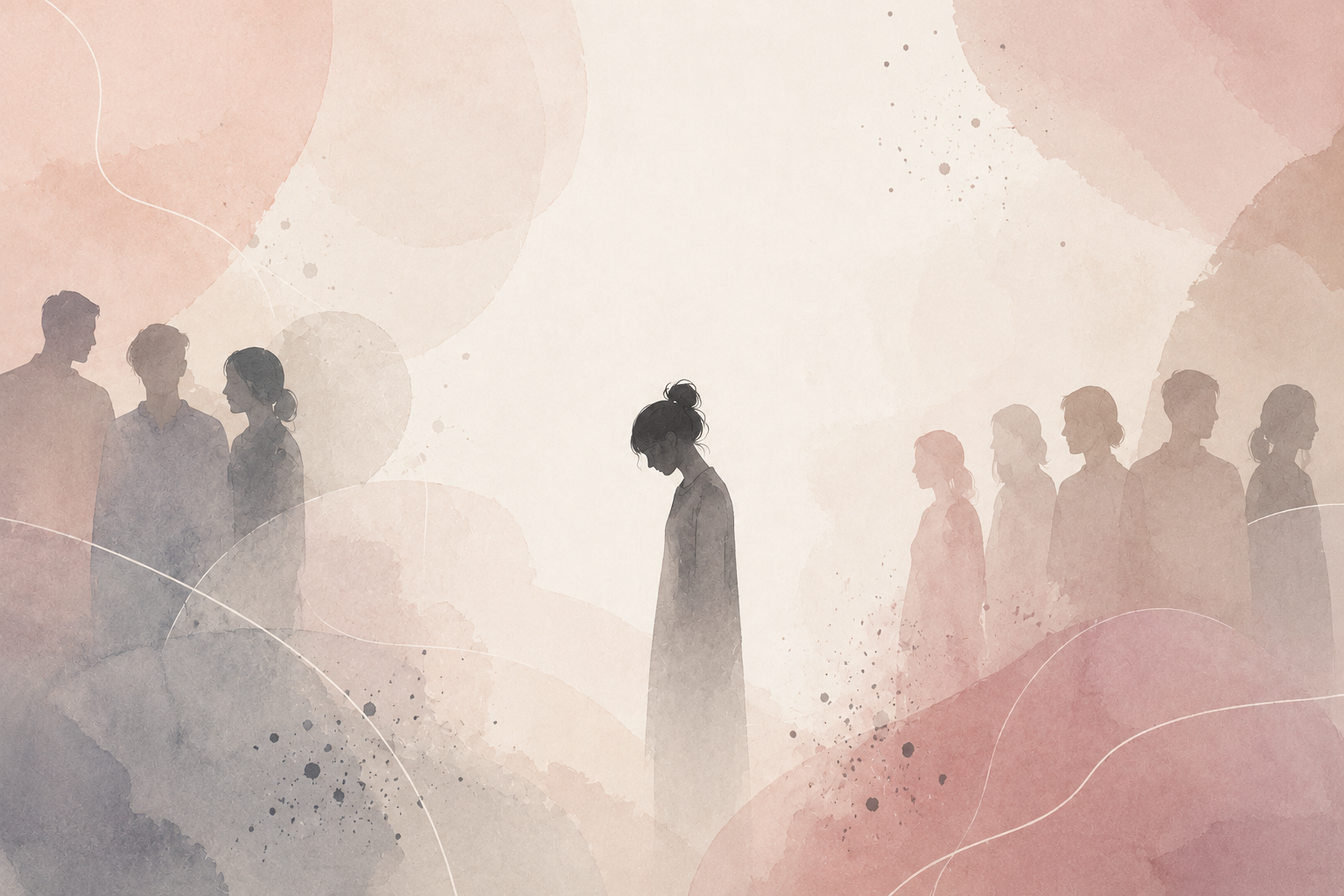
“Don’t mind him. He’s just like that.”
You’ve probably heard a sentence like at least once.
Maybe it’s not a him. Maybe it’s an older sister who’s “too emotional,” or an uncle who’s “always creating drama,” a cousin who’s “too outspoken.”
As normal as that sounds, what we often fail to acknowledge is how comfortably they settle into family life and before you know it, they become introductions:
“She’s the responsible one.”
“He’s the funny one.”
“That’s the stubborn one.”
“She’s always been sensitive.”
When you repeat them long enough, it starts to become facts. Or at least they feel like facts. However, nobody remembers when these descriptions began to take shape.
And that’s what got me thinking…
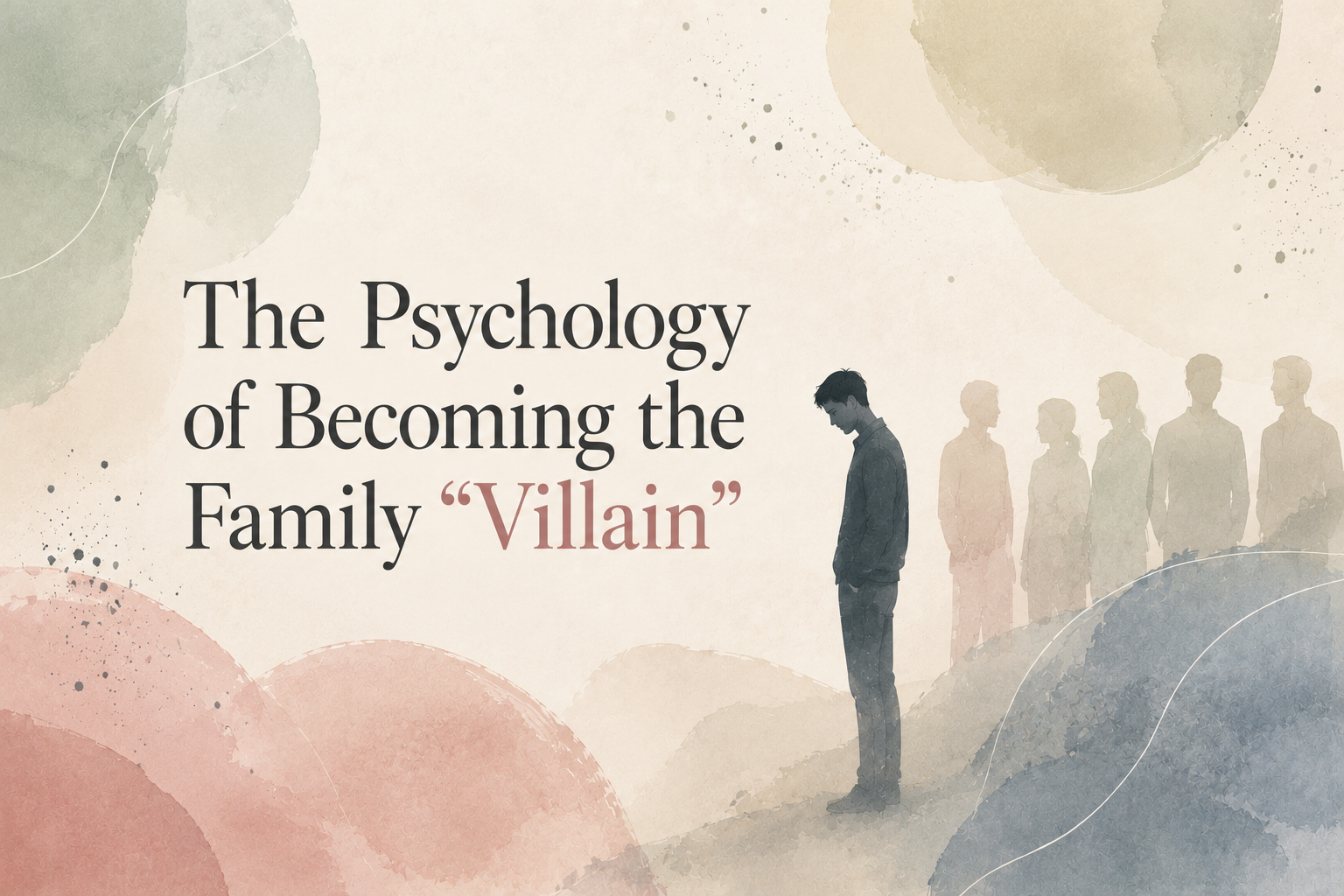
How does one person become the difficult one? Or the black sheep? Or the person whose name somehow finds its way into every conversation about what’s wrong with the family?
More importantly, why does this happen in so many families? Even families that genuinely love one another.
Maybe the “villain” isn’t actually a villain
No parent wakes up on a random Tuesday, sips their morning tea, and thinks, “You know what this family really needs? A designated problem child!”
From my understanding, the word “villain” is simply a convenient label for a role that many families unknowingly create.
And that’s the keyword – it’s a role, not a personality. Meaning that it’s not something people choose to be nor is it something families consciously assign to a family member.
What actually happens is much more subtle and, if you ask me, far more interesting.
To understand it, we have to stop looking at individuals in isolation and start looking at families the way Murray Bowen suggested we should: as emotional systems.
That single change in perspective changes everything.
Families Are More Than the People Inside Them
Most of us grow up thinking of families as collections of individuals.
There’s Mum.
Dad.
The eldest sibling.
The middle child.
The youngest sibling.
Grandparents.
Everyone has their own personality, their own habits, their own quirks.
It seems straightforward enough.
But the Bowen Family Systems Theory invites us to look at family as an emotional unit and not as a group of separate individuals living together. In other words, what happens to one person inevitably influences everyone else, and everyone else’s responses influence that person in return.
This might sound obvious at first because of course, families affect one another. But this theory dives in much deeper than that.
He argued that an individual’s thoughts, feelings, and behaviours cannot be fully understood in isolation because they develop within an emotional system. If we only look at one person’s behaviour without paying attention to the relationships surrounding them, we’re likely to miss a large part of the picture.
Imagine walking into your kitchen and finding water all over the floor. You could spend all day mopping it up, but if you never look up to notice the leaking pipe, the floor will keep getting wet. So you see, the puddle isn’t the whole problem. It’s just the part of the problem that’s easiest to see.
Families can work much in the same way. Sometimes the person who’s struggling the most isn’t the source of the family’s difficulties. They’re just the place where those difficulties have become most visible.
The tricky part about all this is that emotional systems aren’t obvious while we’re living inside them. Unlike a leaking pipe, there’s usually no single moment where everyone notices, points to the leak, and says, “Well, that’s the problem.”
Instead, emotional systems reveal themselves through everyday interactions.
Think about something as ordinary as a family dinner.
Everything is going well until someone makes an offhand comment. It doesn’t even have to be an argument. It could be a harmless question about someone’s job, a passing remark about marriage, or an old family story that accidentally touches a nerve.
Within moments, the room seems to reorganise itself. Someone rushes to change the subject. Someone else tries to make everyone laugh. Another person suddenly becomes quiet. Before long, the conversation has moved on, but the emotional shift is hard to miss.
Nobody planned this. Nobody discussed it. The emotional system just responded.
When Nobody Says Anything, But Everyone Knows
Which naturally raises another question: If families are constantly responding to one another, what exactly are they responding to?
Is it the words being said? The argument itself? Or is there something happening beneath the surface that influences everyone in the room, even before anyone has spoken?
Bowen believed there was.
Families are known for passing down all sorts of things – Traditions. Recipes. Heirlooms. Surnames. The family nose. That one oddly specific way of making tea that everyone insists is the only correct way. And if you’re incredibly fortunate, maybe even a little generational wealth, while the rest of us inherit a thousand books’ worth of stories that begin with, “Back in our day…”
But tucked away with all these inheritances is something nobody ever puts in the will: anxiety.
Not in the sense that you’re destined to inherit it genetically, but in the way these relationships shape how we respond to stress.
This was one of Bowen’s key observations. He believed that anxiety doesn’t simply belong to one person. It moves through relationships. Within families, it often becomes a shared emotional experience.
When one family member becomes chronically anxious, everyone else, without realising it, begins adjusting their behaviour in response.
A father who’s been under enormous financial stress for months says very little about it, believing he’s protecting his family. But without meaning to, he becomes shorter in conversation, less patient, more easily frustrated. His partner begins walking on eggshells. One child becomes unusually helpful around the house, while another starts spending more time in their room.
Nobody sat down and agreed to respond this way. Yet everyone adjusted to the emotional climate in the home.
Now stretch that over ten years. Or twenty. Or three generations.
Those repeated responses slowly become patterns. And before you know it, those patterns become the way the family functions.
And it’s these repeated patterns of responding, adapting, and adjusting that make a family more than just a group of individuals. They make it an emotional system.
The Comfort of Familiar Patterns
If these patterns are simply responses to emotional tension, why do families often find themselves having the same arguments, relying on the same people, and returning to the same ways of relating, even when everyone involved wishes things were different?
Homeostasis:
Bowen believed emotional systems have a remarkable tendency to pull themselves back towards what feels familiar. He called it homeostasis – the system’s tendency to maintain stability.
Most of us assume families naturally move towards healthier ways of functioning. Sometimes they do, but very often, we move towards what feels familiar. Even when this familiarity isn’t particularly healthy. Because predictable patterns can feel safer than uncertainty.
When this happens, the family returns to equilibrium, the emotional waters become calm again. At least for a while.
Invisible rulebook:
If homeostasis is how families maintain stability, then invisible rules are often how that stability is protected.
I don’t think there are a lot of families around that hold annual meetings where everyone agrees on the rules. In fact, most of the time, the rules are never spoken at all. Some are more obvious like:
Finish your education.
Respect your elders.
Help around the house.
Try not to set the kitchen on fire.
Reasonable enough. Right?
But there are also some rules in this book that nobody has to say out loud:
Don’t disagree with your father in front of guests.
Don’t bring family problems outside of the home.
Nobody talks about your grandfather’s drinking.
Smile for the photograph even if nobody has spoken to each other all afternoon.
Nobody mentions why your aunt stopped coming home.
Here, silence becomes a family language too.
The thing about unspoken rules is that we rarely notice them because they’ve always been there. Simply put, they are brushed off as “this is just how our family is.” And yet these invisible expectations shape how everyone behaves.
Some of these rules create belonging and preserve traditions but they can also make it difficult for families to respond when life changes. Give it enough time, and these rules begin shaping who people become.
If you’re the child who’s always expected to calm everyone down, chances are you’ll keep doing it.
The sibling who always apologises becomes the one everyone waits for.
The person who always challenges the family narrative eventually becomes “the difficult one.”
You see the pattern? Repeated responses slowly become expected responses. And somewhere along the way these expectations replace possibilities.
How Responses Become Roles
Most of us were fed the idea that personality is something people inherently have. But the Bowen perspective pushes us to consider another possibility: What if some of the qualities we describe as personality first began as adaptations?
This thought opens up the possibility to think of these qualities as understandable responses to the emotional environment a person grew up in.
“He’s always been responsible.” Or has he? Perhaps it’s just that he was the first one to notice that nobody else was carrying the responsibility.
“She’s independent.” – Or perhaps she learned early on that asking for help wasn’t particularly safe.
Families often give themselves medals for confidently describing one another. Yet if we rewind far enough, many of those descriptions probably began as responses to particular moments, repeated so often that everyone eventually accepted them as part of who that person was.
Think back to that dinner table from earlier – the offhand comment, the sudden change of subject, the joke, the sudden silence. Now picture it playing out with names attached –
Dad goes quiet. Before anyone asks if he’s alright, your eldest sister has already started talking about work. Your younger brother cracks a joke. Mum suddenly becomes very interested in whether everyone has enough food. Your grandfather asks if anyone watched yesterday’s match.
Nobody appointed mum to smooth things over, or your sister to keep the conversation moving, or your brother to be the one who lightens the mood. And yet, over time, these responses became roles we play within the family system.
Family therapists working from Bowen’s perspective might look at this scene and ask a question many of us wouldn’t think to ask: What function is each person’s behaviour serving within the emotional system?
How do these patterns become roles?
A child is growing up in a home where conflict is unpredictable. One day, after an argument, they tell a joke, everyone laughs and the tension eases. Nobody sits the child down afterwards and says, “Congratulations, you’ve officially been promoted to Family Comedian.” But the family breathes a little easier.
The child learns something here: humour changes the atmosphere. The next time there’s another conflict, they make another joke. Years later, everyone says, “Oh, he’s always had such a great sense of humour.”
Maybe he has. Or maybe humour became the safe way to belong within the family.
This is how many family roles begin. Not through conscious decisions, but through repeated reinforcement. Every time a particular response helps the family return to something that feels calmer, safer, or more familiar, that response becomes a little more likely to happen again. And ultimately, the role feels like who they are. And that’s precisely what makes these roles so powerful.
Which leaves us with an even bigger question: If nobody consciously assigns these roles, why do they seem to settle around particular people?
- Why does one child become the peacemaker while another becomes the rebel?
- Why does one sibling carry everyone’s expectations while another somehow carries everyone’s disappointments?
- Why does one person become “the successful one,” while another becomes “the disappointment”?
The short answer is that there isn’t one answer. There are several answers.
Family systems are wonderfully and frustratingly complex. And different families adapt in different ways.
Different children bring different temperaments into the world.
Different parents carry different histories.
Different cultures reward different behaviours.
And somewhere in the middle of all of that, identities begin to form.
The Worries That Find Their Way to Us
Like we talked about before, parents can sometimes, without intention, pass on their own anxieties through relationships.
You might have noticed that some parents seem to worry far more about one child than the other. Bowen called this the Family Projection Process.
For instance, a parent who constantly worries about failure doesn’t wake up hoping to make one child anxious. Instead, their worry shapes the way they respond to that child. They become more protective, more critical, more watchful. The child gradually learns that the world is something to be feared, not because anyone explicitly taught them to think that way, but because anxiety became a big part of the relationship itself.
Take note of what’s happening here:
Nobody is the villain; nobody is consciously creating harm. Everyone is responding to the best of their own understanding and yet the emotional pattern seems to latch on.
More often than not, the child who becomes the focus of that anxiety grows into the family member everyone worries about or the one everyone tries to fix. Family therapists refer to this person as the identified patient.
The name can sound a bit clinical, but the idea is simple: when a family is under emotional strain, one of the member’s struggles can become the most visible expression of difficulties that already exists in the system. In other words, the family’s distress becomes concentrated in one place.
Think back to the kitchen from earlier.
The puddle is still on the floor. You could spend all day blaming the puddle for making the floor wet. You could even become very good at cleaning it up. But unless someone eventually looks up, the leak stays as is. And the sad part is that the leak doesn’t just stay in one place.
Anxiety Finds Other Places to Go
One fascinating thing Bowen noticed was that anxiety doesn’t stay confined between the two people who are experiencing it. But it will begin looking for somewhere else to go.
Imagine that same family dinner one more time.
Mum and Dad have been arguing for weeks but of course, nobody talks about it directly. They still pass the vegetables, ask whether anyone wants more rice, and politely discuss current affairs like nothing happened. But the atmosphere has definitely changed.
Dad starts spending more time talking to his daughter. He asks her opinion about things he would normally discuss with his partner. The daughter becomes the one who comforts him after arguments. Without anyone intending it, she’s no longer standing outside the conflict. She has become part of it.
That’s a triangle.
Whenever tension between two people becomes difficult to manage, it’s common for a third person to become involved. Sometimes it’s a child, sometimes it’s a grandparent, a sibling, an aunt, a family friend, or even a family pet that starts receiving everyone’s affection.
It sounds almost absurd when you first hear it but if you really think about it, you might notice it within your own system.
Have you ever found yourself caught in the middle of an argument that wasn’t really yours?
Or been asked to “talk some sense” into another family member?
Or noticed one parent regularly confiding in you about the other?
The triangle often reduces tension but it doesn’t resolve it. Instead, what happens is that the experienced anxiety changes shape.
And once you begin noticing triangles, you’ll probably start seeing them everywhere. Which, in a roundabout way, brings us back to where this whole discussion started – the villain.
When the Family’s Anxiety Finds a Name
A family experiences stress, everyone begins adjusting, certain responses reduce the tension, those responses become repeated; repeated responses become expected and expected responses become roles.
In some instances, one person’s role becomes carrying what the rest of the family cannot. This is where the idea of scapegoating begins to make more sense. Don’t look at it as an act of cruelty but as something emotional systems can drift towards when anxiety needs somewhere tangible to settle.
The “problem child.”
The “black sheep.”
The “difficult daughter.”
The “disappointing son.”
These labels don’t appear overnight but the end result of years of repeated interactions that slowly organised themselves around one person.
As mentioned earlier, role emerged as a result of the environment the person was put into, not because it was assigned to the person. And that’s an important distinction because it moves the question from, “Who caused this?” to, “What purpose has this role been serving within the family?”
That’s a far more uncomfortable question. But it asks everyone to become part of the conversation. And that conversation, it turns out, isn’t limited to whoever happens to live under the same roof.
Who Else Is Sitting at the Family Table?
Families belong to communities.
Communities belong to cultures.
Cultures carry expectations of their own.
Most of us don’t grow up with just our parents influencing us. We grow up with grandparents reminding us how things have always been done. Aunts who have opinions about our careers. Uncles who somehow manage to ask about marriage before asking how we’ve been. Neighbours who know everyone’s business before their morning tea. Communities that celebrate together, grieve together, and occasionally remind us what “people will say.” Sometimes even the shopkeeper you’ve known since childhood who seems oddly invested in your career choices.
Bowen called this the Societal Emotional Process: the idea that the same emotional forces operating within families can also operate within larger social systems.
In this view, the emotional system becomes much bigger than just Mum and Dad – it stretches across generations, across neighbourhoods and traditions.
Perhaps that’s why changing one family pattern can feel so difficult.
We’re not only responding to our family, we’re responding to generations of expectations that arrived long before we did. And yet, understanding those patterns doesn’t mean we have to be trapped by them.
It offers the opposite. Because once we begin seeing patterns, we also begin noticing where we have these choices.
Perhaps that’s what Bowen’s work was really offering all along – not a way to diagnose families but simply a different way of seeing them.
The moment we start seeing these patterns, curiosity replaces blame. And when this happens, people start looking a little less like fixed characters in a story and a little more like human beings who adapted to the emotional worlds they grew up in.
Of course, that alone doesn’t erase hurt and it doesn’t excuse harmful behaviour.
Understanding is not the same thing as agreeing. But it does remind us that people are often far more than the roles they’ve been given. Maybe the greatest freedom isn’t finally convincing your family that they misunderstood you but recognising that the role you once learned to play is not the whole story of who you are.
And maybe that’s the real question all along. Not, “Who is the villain in my family?” But what if there never was one to begin with?
Only a role that made sense inside a particular system.